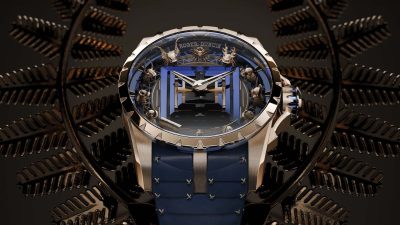

There are collaborations that feel like marketing exercises, and then there are partnerships that make genuine mechanical sense. The Richard Mille RM 64-01 Tourbillon Colnago belongs firmly in the second category. Born from a meeting between one of watchmaking’s most iconoclastic houses and Italy’s most storied racing bicycle manufacturer, this limited-edition tourbillon does something rarer than simply borrowing a logo or a colour scheme. It translates the architecture of a racing bicycle—its tubes, its junctions, its drivetrain—into a hand-wound haute horlogerie movement. For anyone who has ever marvelled at the engineering of a Colnago frame or the skeletal complexity of a Richard Mille calibre, this watch offers a compelling point of convergence. Here is a closer look at what makes it significant, how it works, and why it matters to collectors.
Richard Mille and Colnago: The Collaboration
To understand the RM 64-01, it helps to understand why these two names belong together. Richard Mille has spent more than two decades building watches around the same principles that govern top-tier motorsport and cycling: minimising weight, maximising rigidity, and extracting performance from every component. The brand’s connection to professional cycling is not incidental. Its roster of partners and friends has included Mark Cavendish, Mathieu van der Poel, Tadej Pogačar, and UAE Team Emirates.
Colnago, meanwhile, is not simply a bicycle brand. Founded by Ernesto Colnago in 1954 in Cambiago, a small town outside Milan, the company built its reputation by pushing frame technology forward—helping to establish carbon fibre in the professional peloton and introducing the straight fork, among other innovations. Its frames have carried riders to Tour de France victories, World Championship titles, and Olympic podiums across seven decades.
The relationship between the two brands had been building for years. Richard Mille’s first cycling-specific watch, the RM 70-01 Tourbillon Alain Prost from 2017, was even paired with a bespoke Colnago bicycle for each of its thirty owners. The RM 64-01, however, is the first watch jointly developed with Colnago’s own design team, making it a more deeply integrated exercise than a simple badge collaboration.
Design Inspiration and Cycling Connections
A Movement That Looks Like a Frame
The most striking thing about the RM 64-01 is that its movement does not sit behind a traditional dial. Instead, the calibre is the dial. Its skeletonised construction is built around three principles borrowed directly from frame engineering: lightness, transparency, and structural volume. The grade 5 titanium baseplate and bridges form a tubular architecture that deliberately echoes the geometry of a racing bicycle frame, while also recalling the celebrated RM 012 Tourbillon from 2006.
Star-Shaped Bridges and the Master Frame
Look closely at the upper titanium bridges and you will notice a distinctive star-shaped profile. This is not a random decorative choice. It is modelled after the geometry of Colnago’s Master frames from the 1980s, whose Gilco tube profiles were engineered to increase torsional rigidity without adding unnecessary weight. Micro-lugs elsewhere in the movement pay tribute to Colnago’s C Series, the handmade bicycles that remain central to the brand’s identity.
Colour, Emblem, and the Crank-Arm Hands
The colour palette is drawn from the Colnago C68, a modern road bike that carries the brand’s visual language forward. White, azure blue, and red gold repeat across the bridges, flange, and crown components. The crown cap is finished with a lacquered Ace of Clubs—Colnago’s unmistakable emblem, sometimes described as a four-leaf clover—making the collaboration immediately legible to cycling enthusiasts. Even the hands were designed specifically for this reference: their golden forms echo the crank arms of a bicycle bottom bracket, grounding the watch in the language of the peloton without compromising legibility.
Case Materials and Distinctive Details
The RM 64-01 uses Richard Mille’s signature tonneau-shaped case, measuring 43.21 mm across, 49.94 mm from lug to lug, and 14.23 mm thick. The main case is crafted from White Quartz TPT, a layered composite material made from thinly sliced silica sheets injected with resin. Richard Mille values Quartz TPT for its exceptional rigidity, low weight, and resistance to impact—qualities that translate neatly from racing bicycle construction to wristwatch engineering.
Making its debut on this model is Azure Blue Quartz TPT, a new shade developed specifically for the RM 64-01 and used as inlays in the notched bezels. The notched bezel profile itself sharpens the watch’s dynamic character, extending the diagonal lines of the movement outward toward the case edges.
Another first concerns the use of 5N red gold. While Richard Mille has used precious metals before, this is the first time red gold has been incorporated into the visual identity of one of its sports watches. The red gold flange frames the movement and carries luminous index points, while red gold also appears on the crown cap. The result is a warmer, more layered composition than the brand’s typically cool, technical palette.
Despite its complex construction, the case remains a functional object. It is water-resistant to 50 metres, sealed by two Nitrile O-rings and assembled with 20 spline screws in grade 5 titanium with abrasion-resistant 316L stainless steel washers—fastening hardware chosen with the same seriousness a race mechanic would apply to a bicycle.
Tourbillon Movement and Technical Features
At the heart of the RM 64-01 sits a new manual-winding tourbillon calibre comprising 274 individual components. The movement measures 33.00 mm by 30.80 mm and is just 6.28 mm thick, a compact footprint made possible by its openworked architecture. The skeletonised grade 5 titanium baseplate and bridges are microblasted across their faces, hand-polished to a bevel along every edge, and then treated with a black and grey PVD coating. This finishing sequence produces a shifting play of textures that rewards close inspection.
The Barrel and the Tourbillon
The layout is deliberately symmetrical, and deliberately theatrical. A fast-rotating barrel sits at 1 o’clock, supplying approximately 65 hours of power reserve. Diagonally opposite, at 7 o’clock, is the variable-inertia tourbillon. Together, these two elements evoke the arrangement of a bicycle drivetrain: the barrel answering the chainring, the tourbillon taking the place of the rear cassette, and the going train between them standing in for the chain.
The fast-rotating barrel is not merely a visual device. By reducing mainspring adhesion, it improves the consistency of torque delivery and contributes to a favourable power-reserve curve—the same logic a bicycle drivetrain applies when it seeks to minimise energy loss between the crankset and the rear wheel.
The tourbillon itself is a variable-inertia design. Unlike a traditional index-regulated balance, it uses four adjustable weights on a two-arm Glucydur balance, with a moment of inertia of 11.50 mg·cm² and a lift angle of 53°. This system allows for more precise and repeatable adjustment while improving reliability when the watch is subjected to shocks, assembly, and disassembly. The balance runs at 21,600 vibrations per hour—3 Hz—and is protected by KIF Elastor shock absorbers, with a Nivarox Elinvar balance spring completing the regulating organ.
Finishing and Hand-Painted Details
The upper titanium bridges receive a matte white lacquer before being hand-painted in azure blue and 5N red gold. Microblasted titanium hub caps with blue lacquer complete the visual chain. This combination of industrial precision and manual decoration is central to the watch’s character: it is a high-performance instrument, but it is also an object of craft.
Limited Edition and Collector Appeal
The RM 64-01 Tourbillon Colnago is limited to 50 pieces worldwide and is available exclusively through Richard Mille boutiques and selected authorised retailers. That number places it in familiar Richard Mille territory—small enough to remain genuinely rare, but large enough to constitute a coherent edition with a clear identity.
For collectors, the appeal lies in the specificity of the exercise. This is not a watch that merely adopts Colnago’s colours. Its movement architecture, bridge geometry, handset, crown emblem, and material palette were all developed in dialogue with the bicycle maker’s design team. The result is a piece that speaks simultaneously to two collecting worlds: the haute horlogerie enthusiast who values skeletonised tourbillons and advanced composites, and the cycling connoisseur who recognises the Master frame reference, the C68 palette, and the Ace of Clubs.
The connection to Tadej Pogačar adds another layer of context. Pogačar, a four-time Tour de France champion, races on Colnago bicycles and is a Richard Mille brand partner. His presence at the launch underscored the genuine sporting relationships that underpin the collaboration, rather than a purely commercial tie-in.
Who Is This Watch Designed For?
This is not a watch for someone seeking a discreet dress piece or a conventional everyday wearer. It is designed for the collector who enjoys reading a movement as much as looking at a dial—someone who appreciates the way a skeletonised calibre exposes its architecture and who finds beauty in structural efficiency. It will resonate with enthusiasts of performance engineering, whether their frame of reference is a Formula 1 chassis, a racing bicycle, or a tourbillon carriage.
It also suits the growing overlap between watch collecting and high-end cycling, a demographic that understands why a frame might use star-shaped tubing or why a drivetrain is laid out the way it is. The RM 64-01 rewards that literacy. It assumes an owner who will notice the crank-arm hands, the Master-inspired bridges, and the drivetrain-like symmetry of the barrel and tourbillon—and who will enjoy explaining those details to others.
Conclusion
The Richard Mille RM 64-01 Tourbillon Colnago succeeds because it treats collaboration as an engineering problem rather than a branding opportunity. By allowing Colnago’s frame-building logic to shape the movement’s architecture, its finishing, and even its handset, Richard Mille has produced a watch that feels genuinely informed by its partner’s world. The White and Azure Blue Quartz TPT case, the 5N red gold accents, the 274-component manual-winding tourbillon calibre, and the limited run of 50 pieces all contribute to a coherent and deeply considered object. For collectors who value technical storytelling alongside haute horlogerie, it stands as one of the more convincing cross-industry creations in recent memory—a racing bicycle for the wrist, built with the seriousness of a championship machine.