Editorial
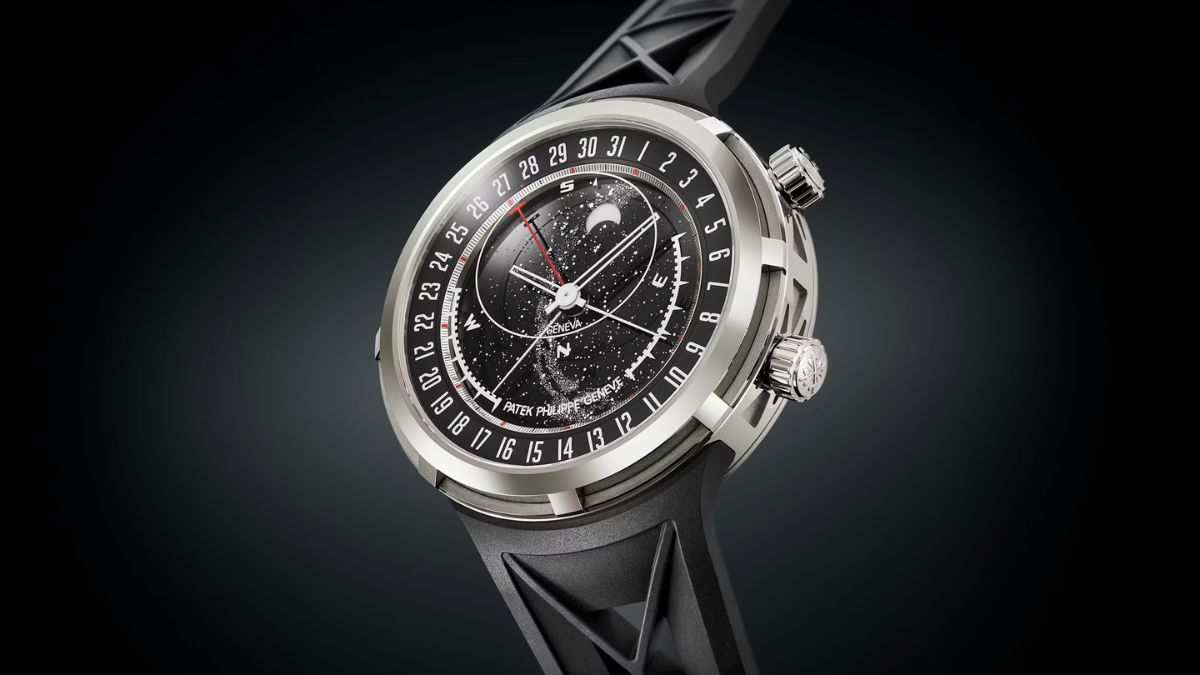
Among the many remarkable releases unveiled by Patek Philippe at Watches & Wonders 2026, few watches captured the imagination of enthusiasts quite like the new Patek Philippe Celestial 6105G-001. While its futuristic aesthetic and celestial display immediately attracted attention, the true innovation lies beneath the dial.
Hidden inside the Celestial 6105G is one of the most fascinating mechanical developments seen in modern watchmaking: a patented compliant mechanism designed to improve the accuracy and efficiency of the sunrise and sunset indications. It is a subtle technical achievement that demonstrates how traditional horology continues to evolve through advanced engineering.
A New Approach to an Old Problem
Displaying sunrise and sunset times mechanically is not a new concept. Traditionally, watchmakers rely on rotating annual cams paired with followers that trace the cam’s profile throughout the year. As the cam turns, the follower moves and translates seasonal changes in daylight into readable indications on the dial.
Although effective, this conventional system has an inherent limitation. The follower typically pivots around an axis, causing it to travel along a curved path rather than a perfectly straight line. This introduces small geometric inaccuracies that must be compensated for through complex cam shapes and additional adjustments.
For most applications the discrepancy is negligible, but for a manufacture such as Patek Philippe, even minor imperfections become opportunities for innovation.
The Beauty of Compliance
Instead of relying on pivoting followers, Patek Philippe developed a compliant mechanism that guides movement through the elastic deformation of flexible structures.
In the Celestial 6105G, the sunrise and sunset cams are read by linear feelers connected to ultra-thin flexible elements. These flexures allow the feelers to move in a perfectly controlled straight line while simultaneously providing the restoring force required for operation. As a result, the mechanism eliminates traditional pivots, return springs, and many sources of friction and play.

The advantages are significant:
- More precise transmission of the cam profile
- Reduced mechanical backlash
- Lower friction
- Fewer components
- Improved long-term consistency
Most importantly, the linear movement means the cam’s geometry can directly represent astronomical data without requiring correction factors that compensate for rotational motion.
Engineering at the Microscopic Scale
Compliant mechanisms are increasingly appearing in high-end watchmaking, but the implementation found in the Celestial 6105G is particularly noteworthy.
The entire assembly is essentially a monolithic structure, integrating guidance and spring functions into a single component. The flexible blades are only fractions of a millimetre wide, demanding manufacturing tolerances that would have been nearly impossible to achieve just a few decades ago.

This approach reflects a broader trend in contemporary horology, where advanced micro-engineering techniques are used to refine traditional mechanical solutions rather than replace them.
More Than Just a Star Chart
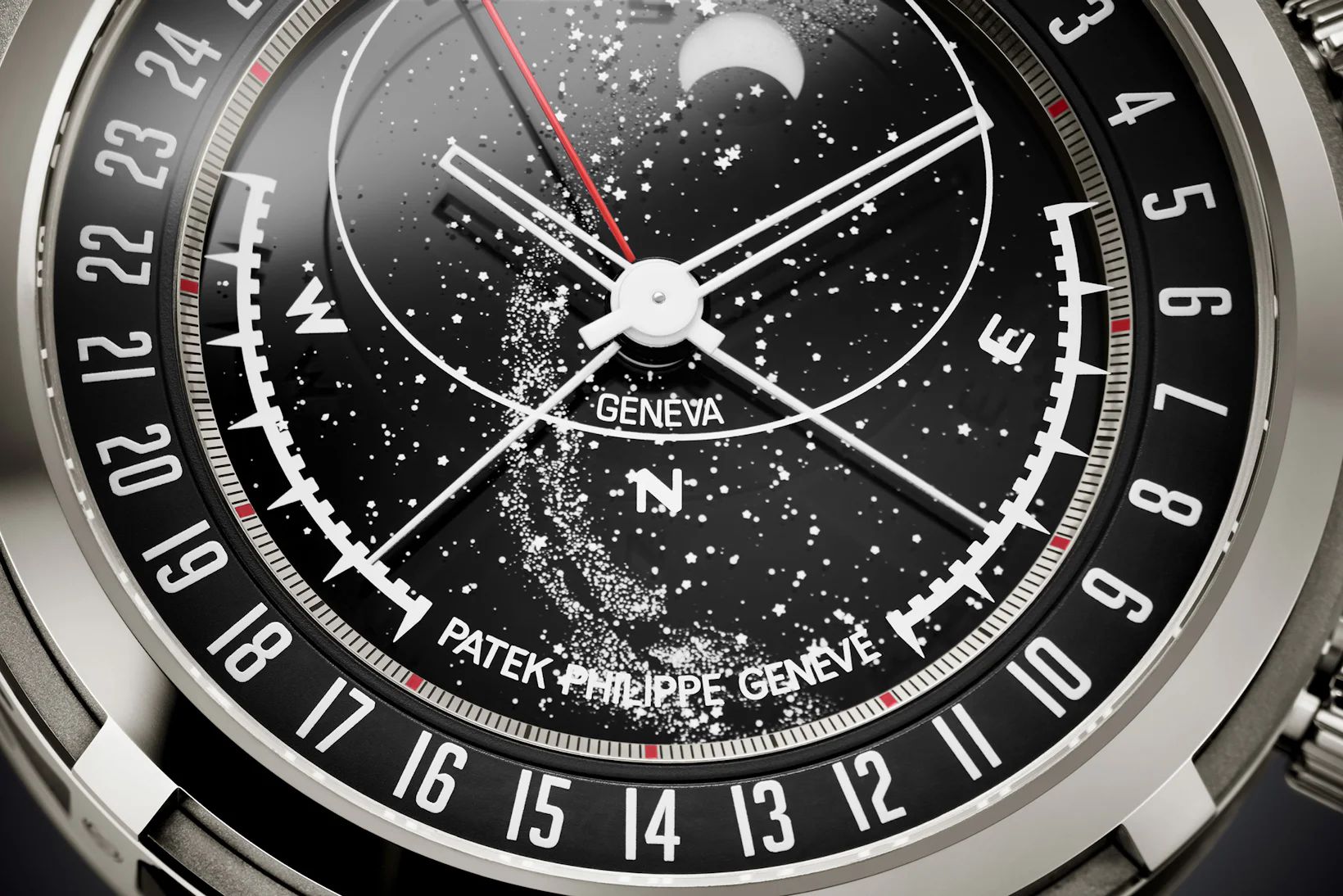
The Celestial collection has long been one of Patek Philippe’s most distinctive astronomical watches. The new 6105G continues that legacy with its rotating sky chart, moon-phase indications, and celestial displays based on the night sky above Geneva.
What makes the 6105G particularly significant is the addition of sunrise and sunset indications together with a daylight-saving-time correction system. For the first time in a Patek Philippe wristwatch, the wearer can adjust for summer and winter time while preserving the accuracy of the astronomical indications. This functionality is supported by six patents and required years of development.

The result is a watch that combines traditional astronomical complications with contemporary mechanical innovation in a way few manufactures can match.
Final Thoughts
Luxury watchmaking often celebrates visible craftsmanship: hand-finishing, guilloché dials, or intricate complications displayed through sapphire casebacks. Yet some of the most impressive achievements remain hidden from view.
The compliant mechanism inside the Patek Philippe Celestial 6105G is a perfect example. It may never receive the same attention as the watch’s striking celestial display, but it represents a sophisticated solution to a longstanding mechanical challenge.
In an era where innovation is increasingly difficult to achieve within the constraints of traditional watchmaking, Patek Philippe has demonstrated that genuine progress still exists—not through electronics or software, but through the elegant manipulation of metal measured in fractions of a millimetre.
That is what makes the Celestial 6105G one of the most technically intriguing watches of 2026.