Few complications in horology command the reverence of the minute repeater. It is a mechanism that transforms a wristwatch from a silent instrument of precision into something almost alive—a tiny, mechanical orchestra that chimes the time on demand with hammers and gongs no larger than a hairspring. For collectors, the minute repeater represents the summit of traditional watchmaking: a fusion of micro-engineering, acoustic artistry, and patience that no other complication quite matches. The pursuit of a great repeater is not merely about owning a function; it is about owning a sound, a piece of history, and a mechanical performance that unfolds anew each time the slide is engaged.
This guide explores ten classic minute repeater watches that have earned their place in collector consciousness. Some are vintage icons born in the golden age of the complication; others are modern masterpieces that push the boundaries of what a chiming watch can do. Each has been selected not for rarity or price, but for its technical significance, its historical weight, and the distinct character of its voice. Whether you are a seasoned collector refining a focused repeater collection or a newcomer beginning to understand why these watches matter, the models that follow offer a considered starting point for a lifelong study.
Understanding the Minute Repeater Complication
Before examining individual watches, it helps to understand what a minute repeater actually does—and why it remains so difficult to execute well.
At its simplest, a minute repeater tells the time audibly. When activated by a slide or pusher, it strikes the hours on a low-pitched gong, the quarter-hours with a double tone combining low and high notes, and the remaining minutes on a high-pitched gong. At 12:59, for example, the sequence can involve up to 32 strikes: twelve low tones, three double tones, and fourteen high tones. The entire performance is mechanically programmed, with snail cams and racks reading the position of the hands and translating that information into a precisely timed acoustic sequence.
The complication emerged from practical necessity. Before electric lighting, telling time in the dark was a genuine challenge, and repeating watches—first clocks, then pocket watches—allowed their owners to hear the hour without striking a match. Early repeaters, however, produced a muffled, imprecise sound. The turning point came in the late 18th century, when Abraham-Louis Breguet replaced the internal bell with coiled wire gongs that wrapped around the movement, allowing the hours, quarters, and minutes to be struck in distinct tones. That fundamental architecture—two hammers, two gongs, and a regulated sequence of strikes—remains the template for every minute repeater made today.
What separates a competent repeater from a great one is not the complexity of the mechanism but the quality of its sound. Tonal purity, volume, cadence, and the absence of metallic harshness are the criteria by which collectors judge these watches, and they are qualities that cannot be measured on a spec sheet. A minute repeater is, in the truest sense, an instrument, and its voice is its signature.
Top 10 Classic Minute Repeater Watches
1. Breguet Marie-Antoinette No. 1160
No discussion of classic repeaters can begin anywhere else. Commissioned in 1783 for Queen Marie-Antoinette and completed in 1827—long after her death—the Breguet No. 1160 is less a watch than a monument of horological ambition. It combines a minute repeater with a perpetual calendar, equation of time, thermometer, power-reserve indication, and an independent seconds hand, all housed in a gold case with a rock-crystal dial. The repeater itself strikes hours, quarters, and minutes on demand, and the watch remains one of the most complicated pocket watches ever conceived.
For collectors, the Marie-Antoinette is significant not because it is obtainable—it is not—but because it establishes the conceptual benchmark for what a repeater can be. It demonstrates that a chiming watch need not be a single-complication object; it can be a complete horological universe. The modern Breguet replica, completed in 2008, allows a select few to experience the architecture firsthand, but the original remains the historical anchor of the entire repeater tradition.
2. Patek Philippe Reference 5078
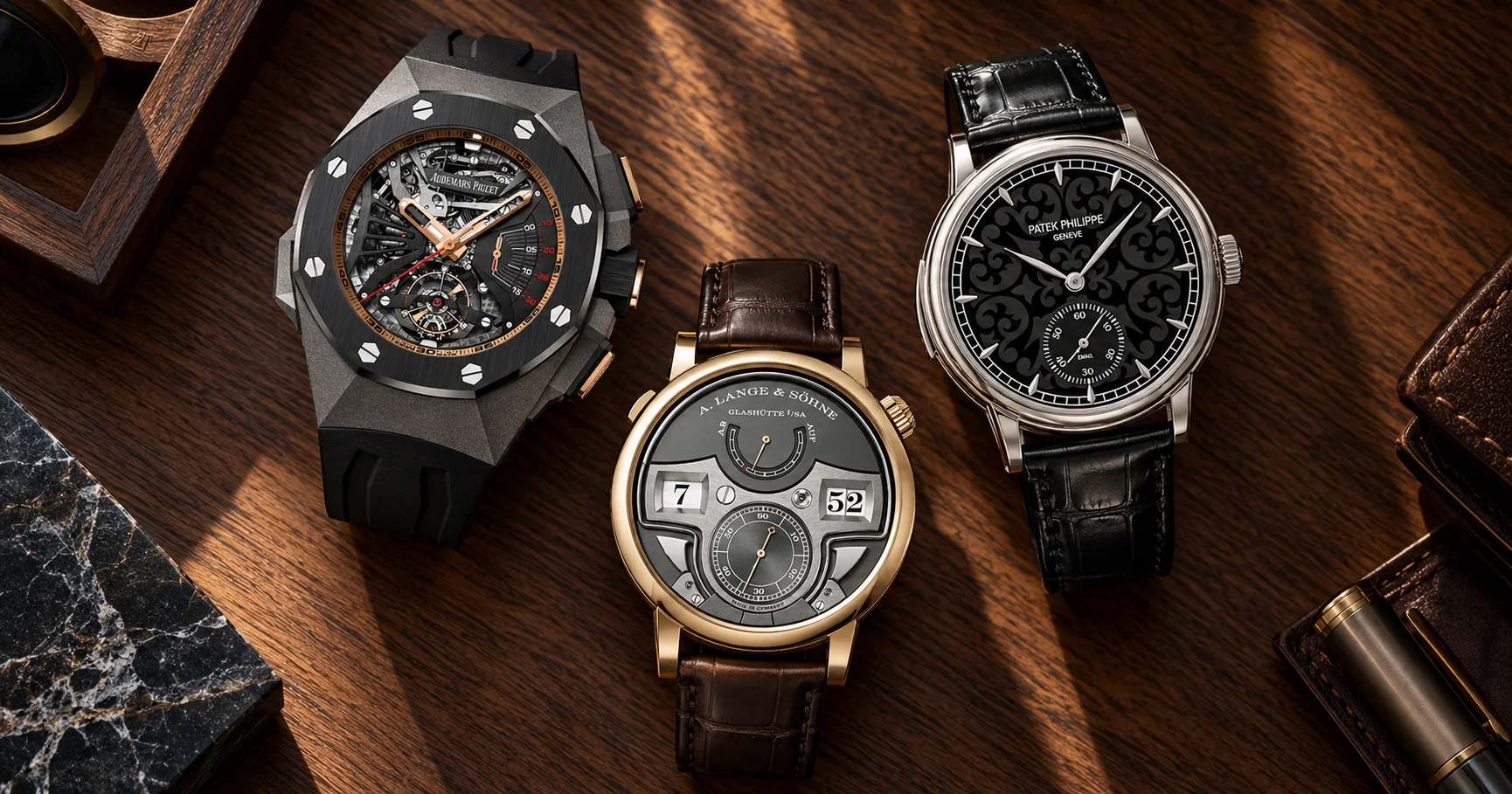
If the Marie-Antoinette defines the past, the Patek Philippe Reference 5078 defines the modern collector’s repeater. Launched in 2005, the 5078 is a self-winding minute repeater built around the caliber R 27 PS, a movement that pairs a micro-rotor with a striking mechanism featuring cathedral gongs. Cathedral gongs wrap around the movement nearly twice, producing a longer, richer reverberation than conventional gongs, and they have become a hallmark of Patek’s most respected repeaters.
The 5078’s appeal lies in its restraint. The case is a classic 38 mm round form, often paired with an enamel dial, and the repeater slide is integrated cleanly into the band. It is a watch that does not announce its complexity until it is activated. For collectors, the 5078 represents the essential modern Patek repeater: technically advanced, aesthetically understated, and voiced with the warmth and musicality that the manufacture has cultivated for more than a century.
3. Patek Philippe Reference 3939
The Reference 3939 occupies a singular place in Patek Philippe’s repeater lineage. Produced from 1993 to 2009, it combines a minute repeater with a tourbillon in a case measuring just 33 mm—a dimension that seems almost defiant given the complexity within. The caliber RTO 27 PS is a hand-wound movement, and the watch is typically fitted with an enamel dial, a material reserved for Patek’s most exclusive references.
Total production is estimated at no more than 200 pieces, averaging roughly twelve per year, which explains why the 3939 remained a connoisseur’s secret for much of its life. Its compact case and classical dial make it a discreet object, but the combination of a tourbillon and a minute repeater places it among the most technically ambitious wristwatches of its era. For collectors who value scholarship over spectacle, the 3939 is a definitive reference—a watch that rewards close study and rarely surfaces on the open market.
4. Audemars Piguet Royal Oak Concept Supersonnerie
Audemars Piguet’s contribution to the repeater story is not a single model but a technological rupture. The Royal Oak Concept Supersonnerie, introduced in prototype form in 2015 and commercialized in 2016, rethinks the fundamental problem of the minute repeater: how to make a wristwatch sound as full and resonant as a pocket watch. The answer lies in a patented case construction that prevents sound absorption and amplifies the chime, developed over eight years in collaboration with the Swiss Federal Institute of Technology Lausanne.
The Supersonnerie is not a traditional repeater in the aesthetic sense—its Royal Oak Concept case is large, architectural, and unmistakably modern—but it is a classic in the sense that it has changed how collectors and watchmakers think about acoustic performance. It proves that the repeater is not a fossilized complication but a field still capable of genuine innovation. For collectors who want a repeater that sounds unlike anything else on the wrist, the Supersonnerie is a landmark.
5. Audemars Piguet Jules Audemars Minute Repeater Supersonnerie
For those who prefer the Supersonnerie technology in a more classical package, the Jules Audemars Minute Repeater Supersonnerie offers the same acoustic engineering within a round, dress-watch case. Fitted with a Grand Feu enamel dial and measuring 43 mm in diameter, it is a larger watch by traditional standards, but the size serves the sound. The manual-winding movement delivers a chime that is notably louder and more present than a conventional repeater, while the enamel dial and platinum case maintain a formal, understated elegance.
The Jules Audemars Supersonnerie is a useful counterpoint to the Royal Oak Concept: it demonstrates that advanced acoustic technology need not be expressed in an aggressive design. For collectors building a repeater collection around sound quality rather than case shape, it is an essential reference, and it represents one of the few modern repeaters that can genuinely surprise a listener accustomed to traditional chiming watches.
6. Vacheron Constantin Les Cabinotiers Minute Repeater Tourbillon
Vacheron Constantin’s Les Cabinotiers collection is the brand’s laboratory for unique and highly complicated pieces, and its minute repeater tourbillons are among the most refined expressions of the complication in the modern era. The Calibre 2755 TMR, which underpins several of these watches, combines a tourbillon with a minute repeater and is regulated by a flying centripetal governor that controls the striking sequence with unusual smoothness. Vacheron Constantin replaced the traditional anchor regulator with a silent centripetal system, eliminating the mechanical noise that can intrude on a repeater’s chime.
The skeletonized Les Cabinotiers Minute Repeater Tourbillon Skeleton, introduced in 2026 as a single-piece edition, takes this architecture and removes the dial entirely, exposing the striking mechanism and tourbillon carriage in full view. For collectors, Les Cabinotiers represents the intersection of technical ambition and artisanal exclusivity: each piece is unique, and the repeater is treated not as a standalone function but as part of a larger horological composition. It is a reminder that the repeater can be as visually dramatic as it is acoustically compelling.
7. A. Lange & Söhne Zeitwerk Minute Repeater
The Zeitwerk Minute Repeater is the great outlier of this list. Instead of reading the time with hands, the Zeitwerk displays it with jumping numerals, and its repeater is a decimal striking mechanism: it chimes the hours, the ten-minute intervals, and the single minutes, rather than the conventional hours, quarters, and minutes. At 12:59, the maximum sequence is 31 strikes, performed in about twenty seconds.
This is not merely a novelty. The decimal repeater is mechanically more difficult to execute than a traditional quarter repeater because the striking mechanism must sample the position of the digital display discs rather than the hands, and Lange engineered a system of three snails connected to the display elements to decode the time reliably. The result is a repeater that sounds different from any other—a double tone marks each ten-minute interval—and a watch that forces the collector to reconsider what a minute repeater can be. For those who value independent thinking in horology, the Zeitwerk is indispensable.
8. Jaeger-LeCoultre Reverso Répétition Minutes
The Reverso Répétition Minutes, unveiled in 1994 as a limited edition of 500 pieces, was Jaeger-LeCoultre’s first minute-repeating wristwatch and the first rectangular repeater ever made. The caliber 943, developed by the renowned watchmaker Eric Coudray, comprises 306 components and fits into the Reverso’s modest rectangular case—a feat of miniaturization that remains impressive decades later.
What makes the Reverso repeater a classic is not simply its shape but its integration. The repeater slide is flush with the case, preserving the Reverso’s clean profile, and the centrifugal governor is visible at 5 o’clock, spinning as the chime plays. The result is a repeater that feels engineered for its case rather than adapted to it. For collectors, the Reverso Répétition Minutes represents a alternative path for the complication: elegant, discreet, and rooted in one of watchmaking’s most recognizable designs.
9. Cartier Tortue Minute Repeater
Cartier’s Tortue Minute Repeater of 1928 is the earliest known minute-repeating wristwatch made by the maison, and it remains one of the most important Art Deco watches ever produced. The Tortue case—a soft tonneau shape created by Louis Cartier in 1912—houses a movement supplied by the European Watch & Clock Co., and the repeater is activated by a slide on the band, striking on gongs in the traditional manner.
The historical significance of this watch cannot be overstated. It demonstrates that the minute repeater was not exclusively the domain of specialist movement makers; it could be integrated into a jewelry house’s design language, and it could be worn on the wrist at a time when wristwatches were still establishing their legitimacy. Examples are exceedingly rare, and surviving pieces are prized for their combination of Cartier design and repeater complexity. For collectors of vintage wristwatches, the Tortue repeater is a grail of the first order.
10. IWC Portugieser Minute Repeater
The IWC Portugieser Minute Repeater brings the complication into the brand’s most elegant collection. Reference 5242, produced in a limited edition of 250 pieces in white gold, pairs the classic Portugieser case with the in-house caliber 95290, a manual-winding repeater movement with 54 jewels. The dial is restrained—a subsidiary seconds register at nine o’clock, applied numerals, and a sunburst finish—and the repeater slide is integrated into the case band without disrupting the watch’s mid-century lines.
The Portugieser repeater is a classic not because it breaks new ground but because it demonstrates how well the complication can coexist with a design that is already complete. The Portugieser does not need a repeater to be beautiful; the repeater makes it extraordinary without making it loud. For collectors who want a repeater that can be worn daily and appreciated for its restraint as much as its sound, the IWC is a compelling choice.
What Collectors Should Consider Before Buying
A minute repeater is a significant commitment, and the criteria for choosing one differ from those applied to almost any other complication. Before pursuing a specific reference, collectors should understand the factors that distinguish a satisfying repeater from a merely functional one.
Sound Is the First Criterion
No photograph, specification sheet, or video can substitute for hearing a repeater in person. Tone, volume, cadence, and the separation between the hour, quarter, and minute strikes are subjective qualities, but they are the qualities that matter most. A great repeater should produce a clear, clean, and rich sound, free from metallic harshness, with a steady and well-paced sequence. Collectors should listen to as many examples as possible—ideally several examples of the same reference, since repeaters are hand-tuned and no two sound identical.
Gongs and Case Construction Matter
The material and length of the gongs play a decisive role in the character of the chime. Cathedral gongs, which wrap around the movement more than once, produce a longer and lower reverberation than conventional gongs. Case materials and construction also influence sound transmission; some modern repeaters use titanium or sapphire components to improve acoustic performance, while traditional precious-metal cases remain the benchmark for warmth. Understanding these variables helps collectors evaluate why two repeaters of similar complexity can sound entirely different.
Condition and Originality
Vintage repeaters are particularly sensitive to condition. The striking mechanism involves numerous finely adjusted components, and improper servicing can compromise both the sound and the reliability of the chime. Collectors should seek examples with documented service history and, where possible, original case parts, dials, and repeater slides. For modern repeaters, completeness of accessories and the presence of original paperwork add confidence, but the primary concern remains mechanical integrity.
Wearability and Case Size
The repeater is a complication that collectors often want to wear, and case size matters. Vintage repeaters were frequently made in small cases—the Patek 3939’s 33 mm diameter is a notable example—and modern collectors have increasingly rediscovered the appeal of more modest dimensions. A repeater that is uncomfortable on the wrist is a repeater that will rarely be enjoyed, so case thickness, lug shape, and overall balance deserve careful consideration alongside the sound.
Complexity and Redundancy
Many repeaters are paired with other complications: tourbillons, perpetual calendars, or decimal striking systems. These additions can enhance a watch’s technical interest, but they also increase servicing complexity and potential failure points. Collectors should decide whether they want a pure repeater—a watch dedicated to the chime—or a multi-complication piece where the repeater is one voice among several. Neither approach is inherently better, but the choice shapes the ownership experience.
Conclusion
The minute repeater endures because it resists reduction. It cannot be appreciated through specifications alone, and it cannot be fully captured in a photograph. It is a complication that must be heard, handled, and lived with to be understood. The ten watches discussed here represent different answers to the same question: how should a mechanical watch speak? Some, like the Breguet Marie-Antoinette and the Cartier Tortue, speak from history. Others, like the Audemars Piguet Supersonnerie and the Lange Zeitwerk, speak from the frontier of what is technically possible. And a few, like the Patek Philippe 5078 and the Jaeger-LeCoultre Reverso, speak with a balance of tradition and refinement that defines the collector’s ideal.
For anyone building a repeater collection, the most important advice is also the simplest: listen first. The watch that moves you—the one whose chime you find yourself replaying in your mind—is the one worth pursuing. Everything else is secondary.