Editorial
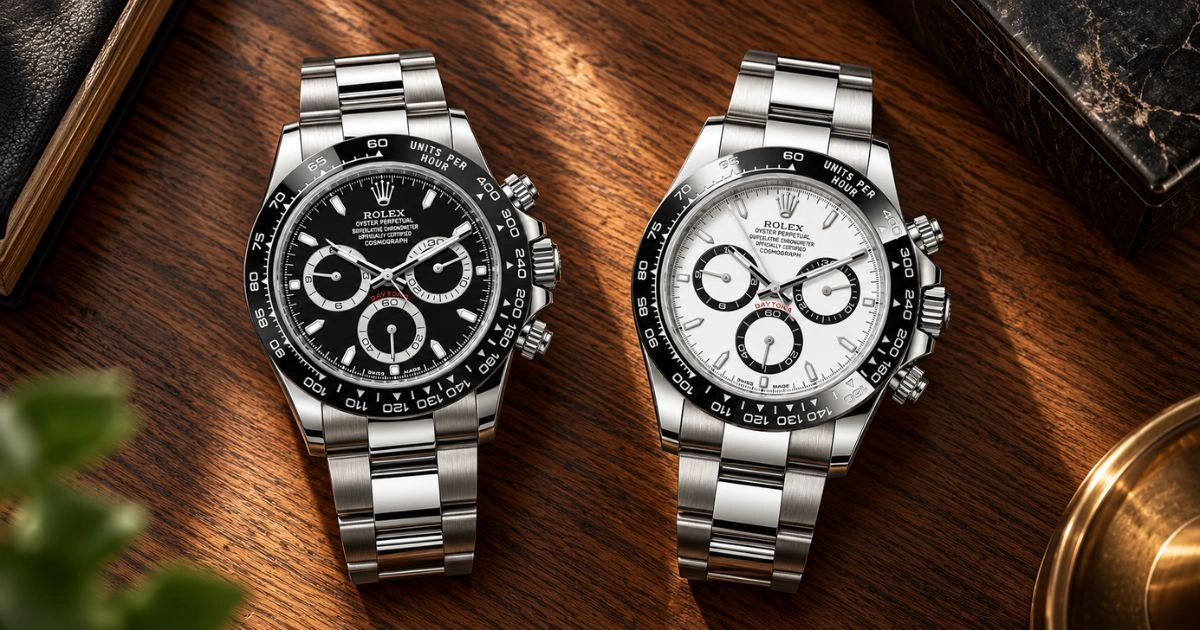
For anyone drawn to the steel Rolex Cosmograph Daytona with a black ceramic bezel, the choice between the 116500LN and the 126500LN can feel deceptively simple. From a distance, these two references share the same 40 mm Oystersteel case, the same Cerachrom tachymeter insert, and the same unmistakable three-register chronograph layout that has defined the Daytona for decades. Yet the closer you look, the more the story changes. The 116500LN represents the generation that turned the steel ceramic Daytona into a cultural phenomenon, while the 126500LN is Rolex’s carefully considered evolution of that formula, introduced in 2023 with a new movement, revised dial details, and subtle case refinements. Understanding what actually changed—and what stayed the same—is essential for collectors deciding which generation best suits their eye and their priorities.
Overview of the Rolex Daytona 116500LN
The 116500LN arrived in 2016 and immediately became the reference that defined the modern steel Daytona era. Its most visible departure from the previous steel model was the black Cerachrom ceramic bezel, a material already familiar from precious-metal Daytona configurations but new to the steel line. The watch retained the 40 mm Oystersteel case and the in-house calibre 4130, an automatic column-wheel chronograph movement that had been the Daytona’s engine since 2000. The 116500LN was produced until 2023 and is now a discontinued generation, which gives it a distinct position in the collector conversation: it is modern enough to be a daily wearer, but old enough to represent a closed chapter in Daytona production.
Overview of the Rolex Daytona 126500LN
The 126500LN replaced the 116500LN in 2023 as part of a broader Daytona range update marking the model’s 60th anniversary. At first glance, it preserves the same core identity: a 40 mm Oystersteel chronograph with a black Cerachrom bezel and an Oyster bracelet. The significant change is inside, where the calibre 4131 replaces the 4130, bringing Rolex’s Chronergy escapement, Paraflex shock absorbers, and a blue Parachrom hairspring into the steel Daytona for the first time. Outside, the 126500LN introduces a revised case profile, a thinner metal ring framing the ceramic bezel, and a dial with slimmer hour markers and redesigned subdial rings. It is, in Rolex’s characteristically incremental way, a refined rather than a reinvented Daytona.
Design and Dial Differences
Subdial Rings and Dial Presentation
The most immediate dial-level difference lies in the subdials. On the 116500LN, the three chronograph registers at 3, 6, and 9 o’clock are framed by relatively bold rings, giving the dial a strong, graphic presence that many enthusiasts associate with the ceramic Daytona’s assertive character. The 126500LN thins those rings noticeably, making the subdials feel more integrated and opening up more of the base dial surface. On a white “panda” dial, this shift creates a brighter, more expansive impression; on a black dial, it produces a slightly more technical, less heavily outlined look. Neither is objectively superior, but the change alters the visual weight of the dial in a way that seasoned Daytona observers notice immediately.
Hour Markers and Printing
The applied hour markers tell a similar story of slimming and refinement. The 116500LN uses broader, cushion-shaped indices that pair well with its bolder subdial rings and give the watch a robust, highly legible personality. The 126500LN narrows the markers considerably, shifting toward a straighter, more pencil-like profile that recalls earlier Daytona references from the Zenith era. The printing on the dial, including the chapter ring and the signature text, was also adjusted in fine detail. One small but telling addition is the tiny Rolex coronet between “Swiss” and “Made” at six o’clock on the 126500LN, a subtle marker of the new generation’s movement.
Bezel Presentation
Both watches use a black Cerachrom tachymeter bezel, but the 126500LN changes how that ceramic element sits within the case. The metal ring surrounding the ceramic insert is thinner on the new reference, bringing the bezel’s visual transition closer to that of precious-metal Daytona models and creating a slightly more refined frame around the scale. On the wrist, this is one of the clearest external cues distinguishing the two references, even though the tachymeter function itself remains unchanged.
Movement and Technical Improvements
Calibre 4130: The Established Benchmark
The 116500LN is powered by calibre 4130, Rolex’s fully in-house automatic chronograph movement. Introduced in 2000, the 4130 was designed around a column wheel and vertical clutch architecture, and it reduced the component count compared with the preceding generation while delivering approximately 72 hours of power reserve. Its reputation is well earned: it is a robust, precise, and service-friendly chronograph calibre that remains highly regarded even by modern standards. For a steel Daytona owner, the 4130 already provides the practical benefits of a modern in-house movement, including chronometer-certified accuracy and a power reserve that comfortably covers a weekend off the wrist.
Calibre 4131: The Technical Evolution
The 126500LN introduces calibre 4131, which is best understood as a technical evolution of the 4130 rather than a wholesale redesign. The power reserve remains approximately 72 hours, and the column-wheel, vertical-clutch chronograph architecture is retained. The meaningful additions are Rolex’s Chronergy escapement, Paraflex shock absorbers, and a blue Parachrom hairspring, all of which are aimed at improving efficiency, shock resistance, and long-term stability. The winding rotor’s ball-bearing setup was also upgraded, and the movement receives Côtes de Genève decoration, though that finishing is primarily visible on precious-metal references with display backs rather than on the steel 126500LN. On the wrist, the daily-wearing difference between the two calibres is minimal, but the 4131 represents Rolex’s latest thinking on automatic chronograph reliability.
Case, Bracelet and Wearability
The case changes between these two references are subtle but worth understanding. The 126500LN received a revised middle case and lug treatment, and the lugs are now symmetrical, whereas the 116500LN had an asymmetric case profile with different lug proportions on the crown side. The crown guards on the 126500LN are also blockier, and the pushers extend slightly farther outward toward the crown’s vertical line. The new case is fractionally thinner and slightly longer lug-to-lug, which can change how the watch sits on different wrist shapes. Both watches use an Oyster bracelet with an Oysterlock safety clasp and Easylink comfort extension, so bracelet functionality is essentially shared. The practical takeaway is that neither reference is a dramatic departure in wearability, but the 126500LN’s case refinements give it a slightly more streamlined, professionally oriented profile, while the 116500LN retains the softer, more rounded case-side character that some collectors prefer.
116500LN vs. 126500LN: Which Should You Choose?
Choosing between these two Daytonas comes down to what you value most in a steel chronograph. The 116500LN appeals to buyers who want the reference that crystallized the ceramic-bezel steel Daytona formula, with bolder dial furniture, a more pronounced bezel-to-case transition, and the proven calibre 4130. Its discontinued status means examples vary widely in condition, so originality, service history, bracelet completeness, and whether the case has been polished become especially important parts of the evaluation. The 126500LN, by contrast, is the current generation, offering the calibre 4131, the latest case and dial refinements, and the assurance of newer production. Buyers who appreciate a leaner, more vintage-inflected dial aesthetic and want Rolex’s newest technical updates will naturally gravitate toward it. Neither choice is a compromise: the 116500LN is not suddenly obsolete because a successor exists, and the 126500LN is not automatically “better” simply because it is newer. The right answer depends on whether your priority is the character of the outgoing generation or the refinements of the current one.
Conclusion
The Rolex Daytona 116500LN and 126500LN are separated by a handful of millimetres, a movement generation, and a series of closely considered design decisions. The 116500LN stands as the reference that made the steel ceramic Daytona a modern icon, with a bolder dial presence and the long-proven calibre 4130. The 126500LN refines that formula with the calibre 4131, slimmer dial elements, a redesigned case profile, and a more delicately framed bezel. For collectors, the comparison is less a contest than a study in how Rolex evolves a classic without erasing its identity. The best choice is the one whose details you notice every time you look down at your wrist—because with two watches this closely matched, personal preference is the only specification that truly separates them.