In the vault of your possessions, few items hold as much narrative and material weight as your high-end luxury watch. It is a chronicle of milestones, a testament to engineering, and a wearable asset of significant worth. Perhaps it was a gift marking a professional triumph, an inheritance carrying generations of stories, or a personal reward for a goal long pursued. Now, for any number of thoughtful reasons, you’re considering its next chapter.
In our digital age, the first instinct is often to seek the path of least friction: a few smartphone photos, a filled-out online form, a click of “submit.” A price, often disappointingly low, materializes in your inbox within hours. This process feels efficient, but for an object of such complexity and nuance, it is a profound disservice. You are not transacting a common commodity; you are stewarding a piece of micro-art, history, and precision. To understand its true value, it must be seen, held, and understood in the light of a connoisseur’s eye.
This is an appeal for the personal, the professional, and the precise. Here is why bringing your luxury watch to a trusted pre-owned specialist for an in-person appraisal is not a step back in time, but the only forward-thinking choice for a discerning owner.
The Digital Disconnect: Where Photos and Forms Fail
Online valuation tools and photo-based quotes are engineered for volume and speed, not for depth or accuracy. They operate on a model of risk mitigation for the buyer, not value optimization for you. The gaps in this system are not mere inconveniences; they are chasms where true worth disappears.
- The Tyranny of the Two-Dimensional Image.
A photograph, even a high-resolution one, is a lie by omission. It cannot convey:
·.
· Case and Bracelet Condition in Three Dimensions: Wear is a narrative. Is the brushing on a Rolex Oyster case sharp and defined, or softly polished? Are the lug edges still crisp, revealing a watch that has been cherished, or are they rounded from an overzealous polish? The subtle curvature of a case, the way light travels along its flanks, the tactile sense of its heft and balance—all are invisible in flat images.
· The Integrity of Finishes: A watch’s value lies heavily in the integrity of its factory finishes—brushed, polished, grained, or matte. Online, a poor-quality aftermarket refinish can be disguised with clever lighting, while an exceptional original finish might be undervalued because it shows honest, even character.
- The Checkbox Conundrum of Online Forms.
These forms force your unique object into a series of binary choices. “Box: Yes/No.” “Papers: Yes/No.” “Condition: Excellent/Good/Fair.” This reductivism is absurd when applied to haute horology.
· What “Papers” Truly Mean: Is it just a stamped warranty card? Is it the full, elegant ensemble of outer and inner boxes, manuals, hang tags, and purchase receipts? The completeness and condition of this set can alter value by thousands. A form cannot capture this hierarchy.
· The “Condition” Fallacy: “Excellent” to one owner might mean worn weekly but carefully; to a dealer, it means near-perfect. Does the crystal have a hairline scratch visible only at a specific angle? Is there a barely perceptible hairline on the caseback from a single strap change? The language of condition is a dialect spoken fluently only in person, with a loupe.
- The Impossibility of Authentication from Pixels.
The pre-owned market, unfortunately, is a target for sophisticated counterfeits, “frankenwatches” (assembled from non-original parts), and watches with replaced components. An online appraiser, working from photos, is making an educated guess at best.
· Movement Truth: The heart of the watch is its movement. Is the finishing correct for the era? Are the plates and gears untainted by corrosion or amateur repair marks? Are the screws blued or polished as they should be? A photo of a caseback cannot answer this.
· Part Harmony: Are the hands, dial, bezel, and crown all perfectly period-correct for the serial number? For vintage pieces, this is a labyrinthine study. A modern replacement hand on a vintage watch can slash its collector value. This requires physical, magnified inspection.
- The Human Element, Absent.
When you submit a form, you are a data point. When you walk into a reputable pre-owned shop, you become a collaborator in the valuation. You can share the watch’s story: “It was purchased in Geneva in 1985,” or “It was serviced last year by the manufacturer.” This narrative has value. A relationship is formed. Trust, the foundational currency of luxury transactions, cannot be built through a web portal.
The In-Person Advantage: A Symphony of Appraisal
Contrast the digital void with the experience of a professional, in-person appraisal. It is a multi-sensory evaluation that respects the object and its owner.
- The Dance of Light: Seeing What Photos Hide.
Under the focused, adjustable lighting of a specialist’s desk, your watch reveals its true character. They will tilt it, turn it, and observe it from every angle. This dance reveals:
· Dial Nuance: That elusive “silver” dial might reveal itself as a stunning silvered opaline. The infamous “ghost” bezel on a vintage GMT-Master, faded by sun and sea, shows its unique, mottled personality. These are the features that make collectors’ hearts beat faster and that algorithms cannot price.
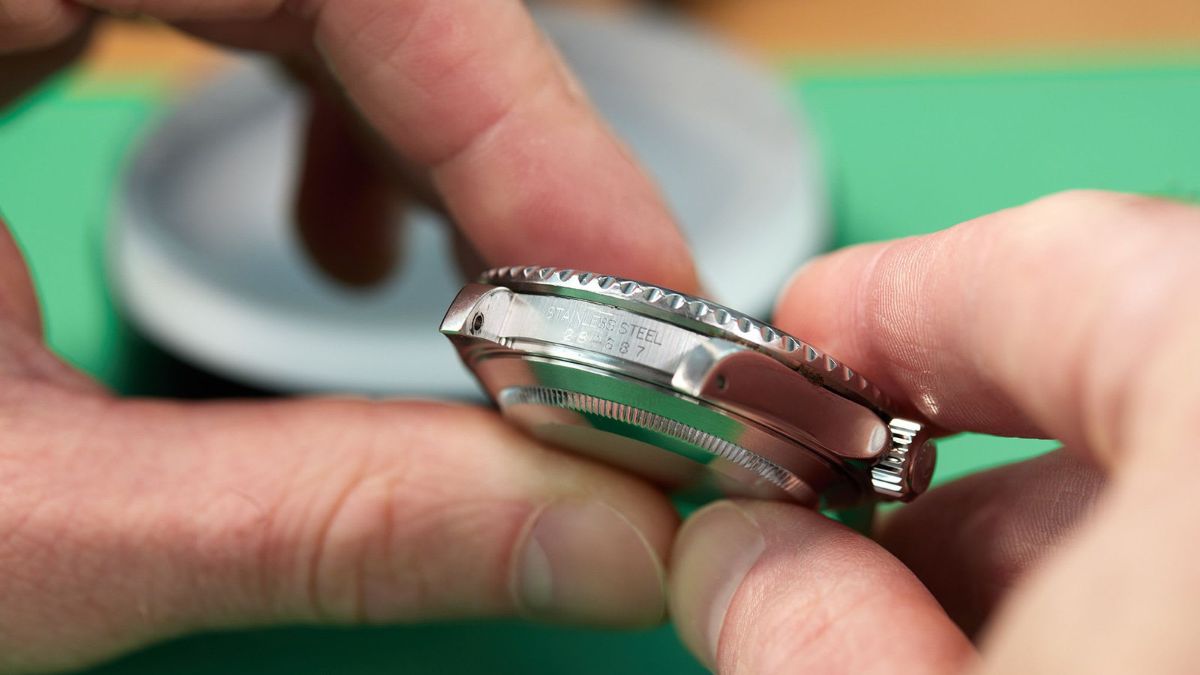
· Case Integrity: With light raking across the surface, every polish, every ding, every original factory edge becomes a clear part of the watch’s history. An expert can distinguish between benign desk-dive scratches and damage that affects structural integrity.
- The Loupe’s Truth: The 10X Magnification of Value.
The jeweler’s loupe (or a binocular microscope) is the great truth-teller. This is where the appraisal moves from opinion to forensic analysis.
· Microscopic Examination: The specialist will examine the laser-etched crystal coronet on a modern Rolex, the infinitesimal printing on the dial text, the quality of the lume application. They’ll inspect the case between the lugs for authentic, crisp engravings of the model and serial numbers, looking for signs of alteration or re-engraving.
· Movement Verification: For watches with display casebacks, or if the caseback is opened (with your permission), the movement can be inspected. The quality of Geneva stripes, perlage, anglage, and the signature of the finisher are all visible. This is the ultimate authentication step, confirming the watch’s soul is genuine and undisturbed.
- The Tactile and Functional Assessment.
Holding the watch tells a story that seeing cannot.
· Bracelet and Clasp Feel: Does the bracelet have the correct, satisfying heft? Does the clasp open and close with the precise, buttery action intended by the manufacturer, or is it gritty or loose? Are the links tight, or is there excessive stretch? This directly impacts value.
· Functionality Check: The specialist will carefully wind the watch, set the time, and engage any complications—chronographs, calendar advances, GMT hands, moon phases. They assess the smoothness of operation, the click of the bezel, the feedback of the crown. A malfunctioning chronograph reset can indicate a need for costly service, which must be factored into an offer.
- The Contextual Conversation.
This is the irreplaceable human core. Sitting across from an expert, you engage in a dialogue.
· Story Becomes Provenance: You provide the history. They provide the market context. “This is a Mark I ‘Fat Lady’ dial, which is particularly sought-after.” Or, “The bracelet on this model is often replaced; the fact that yours is original and in this condition is a major plus.”
· Transparent Education: A good dealer will explain what they’re seeing. “You see here, the lume on the hands has aged to a perfect custard color, matching the dial plots, which is fantastic.” Or, “The case has been lightly polished, but the hallmarks remain sharp.” You learn about your own watch, making you an informed seller whether you proceed with them or not.
· Realistic Market Positioning: They can explain why they are arriving at a figure. They can reference recent auction results, private sales, and current dealer inventory for comparable pieces. This isn’t a black-box algorithm; it’s a reasoned, defendable market analysis shared with you in real-time.
Navigating the Process: How to Prepare for Your In-Person Appraisal
To maximize the benefit of your visit, a little preparation is key.
- Do Light Research: Have a general idea of your watch’s reference number (often between the lugs) and model name. This helps start the conversation.
- Gather Everything: Bring every single thing you have related to the watch: the inner and outer boxes, warranty cards/papers, instruction manuals, service records, receipts, and even the original purchase袋. This “full set” completeness dramatically affects value.
- Be Honest About History: Share what you know about its service history, any repairs, and how it was worn. Transparency builds trust and allows for the most accurate assessment.
- Choose the Right Dealer: Research pre-owned shops. Look for established businesses with strong reputations, professional affiliations, physical premises, and expertise in your brand (e.g., a Rolex specialist, a vintage Patek expert). Read reviews and seek personal recommendations.
The Psychology of Value: Beyond the Number
Finally, an in-person appraisal acknowledges the psychology of luxury. You are not merely selling an asset; you are transitioning a possession with emotional resonance. A respectful, expert appraisal validates your ownership experience. The number presented, even if it is not one you accept, comes with a context and a face. It feels considered, not generated.
The lower offer from an online form often feels like a rejection of the object’s significance. The offer from a professional who has spent thirty minutes marveling at your watch’s details comes with the implicit message: “I understand what this is. I respect it. This is what I can pay to honor it in my inventory.”
Conclusion: The Unautomatable Authenticity
In a world racing to automate every transaction, the luxury watch stands as a defiant monument to human artistry, history, and connection. Its value is not a simple calculation of metal weight and age. It is a tapestry woven from originality, condition, provenance, beauty, and market desire.
To capture that value, you need more than a server and an algorithm. You need a quiet room, focused light, a magnifying loupe, and—most importantly—the accumulated knowledge and discerning eye of a specialist who speaks the language of horology fluently.
Bring your watch in. Let it tell its full story. Allow it to be understood in the round, in the light, and in the hand. You will receive not just a price, but an education and a valuation rooted in tangible, respected reality. Your watch, a masterpiece of personal and mechanical history, deserves nothing less.
Contact me and make apointment, where time is respected, details are celebrated, and value is a conversation, not a form.