Social

Editorial
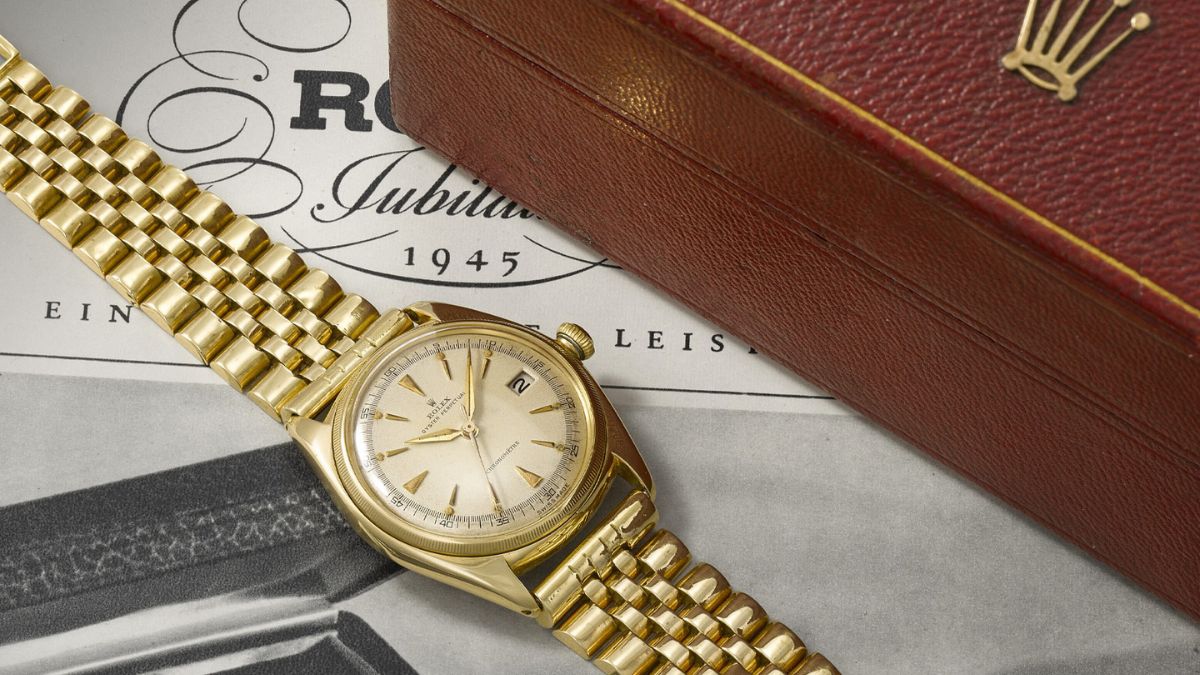
This year marks the centenary of the Rolex Oyster. While Mercedes Gleitze’s Channel swim—and the masterful publicity that followed—took place the year after, 1926 remains the true birth year of the Oyster. That was when the first patents were filed and the earliest Oyster watches were sold. I can state this with confidence: my own very early Cushion Oyster bears the Glasgow date hallmark “d,” unequivocally identifying it as a 1926 piece. To honour this milestone, it’s worth tracing the legacy of what is arguably the most influential wristwatch ever created, through three of its most significant and defining models.
Oyster

I would argue that the Oyster was the watch that changed watchmaking forever. Yet it wasn’t the watch alone that proved so disruptive; it was Hans Wilsdorf’s extraordinary instinct for publicity that truly set it apart. At a time when most watchmakers relied on quiet reputation and trade networks, Wilsdorf understood the power of narrative and visibility. To that end, he enlisted S. T. Garland, a small and newly established London advertising agency—an audacious choice, given that Britain’s advertising landscape was then dominated by the far larger and more entrenched firms of Fleet Street and the West End.

It was likely Garland who first conceived the idea of linking the Oyster to Mercedes Gleitze’s Channel swim, and it was certainly the agency that devised the now-legendary front-page advertisement in the Daily Mail. The campaign was almost certainly reinforced at street level by Rolex retailers, who displayed the new Oyster in shop windows inside goldfish bowls filled with water and live fish, the watch fully submerged—an arresting and unforgettable demonstration of its water-resistance.
These promotions did more than sell a watch; they reshaped public perception. They proved that the wristwatch could be a reliable, everyday companion and, in doing so, accelerated the long decline of the pocket watch’s dominance in men’s timekeeping. In the years following the First World War, wristwatches had become increasingly common, yet they were still widely regarded as fragile instruments, vulnerable to moisture, dust, and shock. This lingering perception was precisely why the pocket watch continued to reign supreme—until the arrival of the Oyster.
Oyster Datejust

Nineteen years after the debut of the Oyster, Rolex unveiled another watch that would fundamentally alter how people understood the wristwatch: the Datejust. Date displays on wristwatches were nothing new—Rolex itself had produced date-equipped watches as early as 1915—but these early solutions, typically using pointer-date mechanisms, were awkward and impractical in daily use.
The Datejust was different. For the first time, it brought together four defining elements of the modern wristwatch in a single, coherent design: a waterproof case, chronometer-certified precision, a self-winding movement, and a discreet yet highly legible date window positioned at 3 o’clock.
The true significance of that date window becomes clear when viewed in its original context. At launch, the Datejust was offered exclusively in 18-carat gold, aimed squarely at an upper-middle-class clientele. And until relatively recently—barely two decades ago—what did people in that demographic do every day? They wrote cheques and letters, activities for which an immediate, reliable reminder of the date was not a luxury, but a practical necessity.
Oyster Submariner

Nine years after the Datejust’s debut in 1945, Rolex once again reshaped the watch world with the introduction of the Submariner. Buying a Cushion Oyster at the end of the 1920s did not mean you intended to swim the English Channel, just as purchasing a Submariner in the mid-1950s did not imply a plan to descend to 600 feet. In both cases, however, the promise was the same: the watch would survive the journey.
That durability was the Submariner’s defining appeal. It was a wristwatch capable of withstanding almost any punishment its owner might inflict upon it. More importantly still, it established the blueprint for virtually every dive watch that followed. Guaranteed depth resistance, a black dial with large luminous indices, oversized luminous hands, and a rotating timing bezel became the universal language of the category—features subsequently echoed in watches such as the Eterna Kon-Tiki, the Omega Seamaster 300, and the Blancpain Fifty Fathoms.
As Rolex marks the centenary of the Oyster and its permanent transformation of the wristwatch, it is worth reflecting on its most important descendants. Like the original Oyster itself, they did not merely refine existing ideas—they redefined what a wristwatch could be.
Related posts

Inside the Patek Philippe Celestial 6105G
Among the many remarkable releases unvei...

Zenith Release G.F.J. Calibre 135 Double Signed with Naoya Hida & Co.
One of the most significant aspects of Z...

爱彼联手Yoon、Verbal创作38.5mm皇家橡树概念时计限量款/AP Royal Oak Concept
爱彼Audemars Piguet携手时尚品牌AMBUSH创办人Yoon与Ver...

New Release: The Audemars Piguet X Swatch Royal Pop Aims To Capitalize On Hype Culture
When rumors first began circulating abou...
New Release: Patek Philippe Celebrates 50 Years of the Nautilus With Four Limited -Edition Watches
Fifty years is a long time for any desig...
New Release: Cartier Santos-Dumont Watches In Yellow Gold and Platinum
In 1904, Louis Cartier created a watch f...
New Release: The Rolex Oyster Perpetual Jubilee Dial Watches Revive A Favorite 1970s Design
Among its Watches and Wonders Geneva 202...

New Release: The Rolex Oyster Perpetual 41 ‘Oyster 100’ Ref. 13403 Tastefully Celebrates A Century Of Oysters
Watches and Wonders Geneva 2026 has arri...

New Release: Rolesium Rolex Daytona 126502 With Enamel Dial
Under a new “Exceptional Creations” umbr...
New Release: Rolex Yacht-Master II Watch Returns
After its quiet discontinuation in 2024,...

New Release: Rolex Datejust 41 White Rolesor Green Lacquer Ombre Dial Watch
The Rolex Datejust celebrates its 81st y...
New Release: Rolex Oyster Perpetual 28 & 34 With Stone Laquer Dials
As part of its Watches and Wonders Genev...